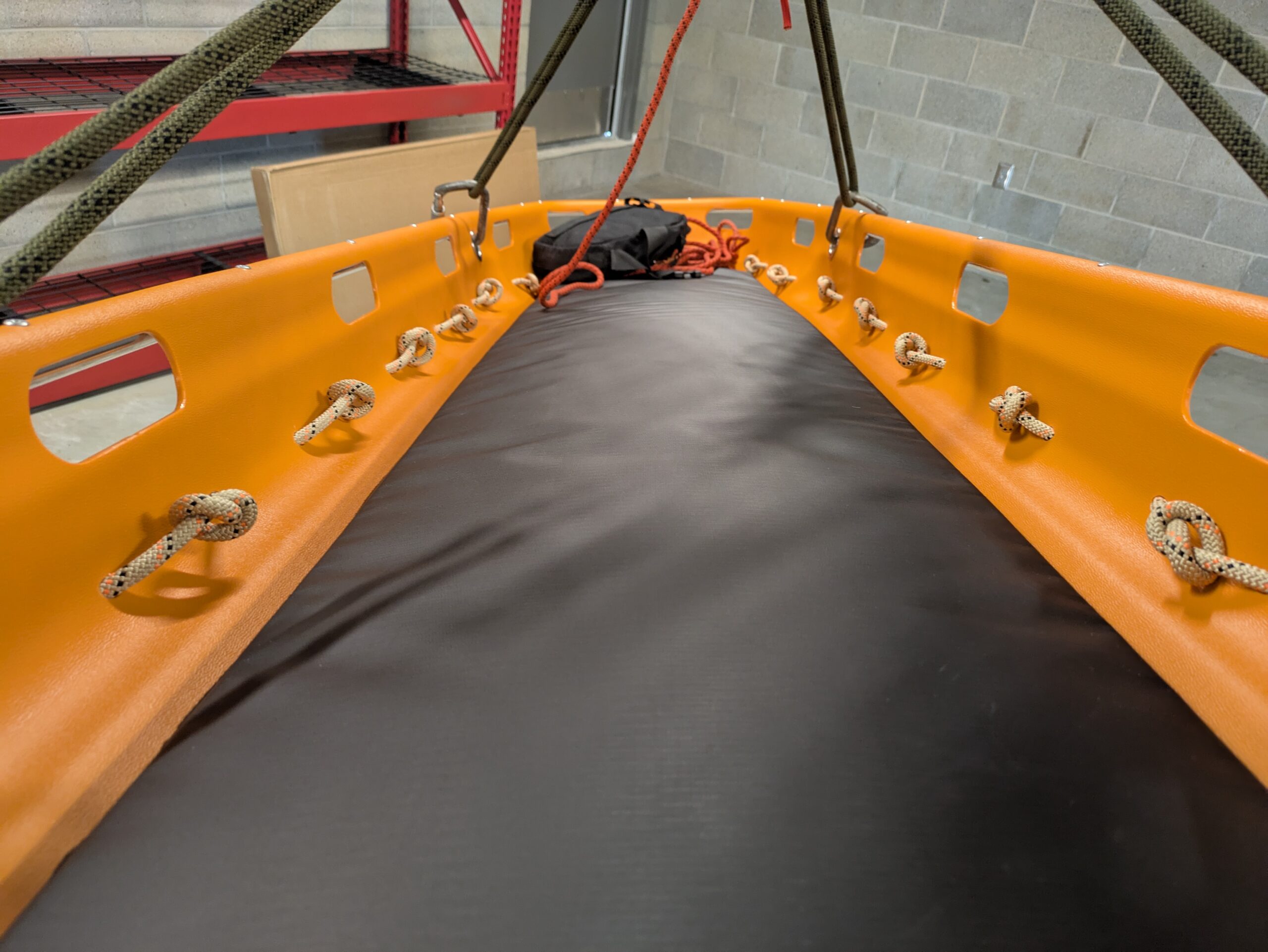
TL;DR: I used 28 feet of Sterling C IV canyoneering rope and overhand knots to replace the standard cord on my Ferno 71.

I know of a few organizations (National Cave Rescue Commission being one) who regularly use the Ferno 71. Most of these organizations choose to replace the standard “Pre-Rigged Nylon Rope for Attaching Restraints” with 8 mm or 9 mm accessory cord or rope.

With many of these Fernos, the replacement cord is pretty snug, and threading webbing through is difficult. I’ve wondered how much of this is because new nylon cord was used, and the cord shrunk after being wet.
I wanted to experiment with a looser cord, figuring if I don’t like it, I can tighten it and trim it later.
For the cord, I chose Sterling C IV because of the lovely durable Technora sheath, and the 9mm diameter. I expect this to be far more abrasion resistant than an 8mm nylon accessory cord.
To avoid trouble with rope shrinkage later on, I took a new C IV, which measured in at 153 ft, and soaked it in water for a few hours, then dried it. After drying, I measured it as being 150 feet. Not being sure quite how accurate my cordage meter is, I’m not sure how much of the three feet difference was shrinkage, and how much was inaccuracy . Regardless, it did not shrink as much as a nylon on nylon rope. The C IV is Technora sheath, braided polypropylene core, which is a little odd, and probably why it didn’t shrink much.

After hoisting the Ferno to a better working height, I removed the “Pre-rigged rope.”
Then, I took the C IV, and tied 20 overhands plus two double overhands, and measured it against the factory installed cord. I cut the knotted rope a bit longer than the factory one, so I’d hopefully have enough rope.
Since C IV is pricey, I wanted to avoid wasting cord. I could have started with the whole 150 feet of rope, but tying 20 overhand knots with between 120 and 150 feet of tail is NOT a good time. So, if I tied all the knots I would eventually tie, and measured against the factory cord, and added a few feet extra, and cut it, I’d probably be pretty close.
As it turns out, I cut the cord about 7 feet too long, which isn’t terrible.
The factory cord terminates at the feet; I started at the head to leave more room for the double fisherman.

Knots on the inside makes it easier to thread webbing through when lashing patients. Should part of the cord fail, the knots would prevent the cord from pulling out entirely.

No knots on the outside. I feel like knots on the outside would provide more backup in case of line failure, but I also think knots on the outside would be more prone to problematic abrasion. I also haven’t heard of anyone having serious problems with these cords wearing through, so maybe knots on the outside wouldn’t be a problem.

Technora is very heat resistant. A “hot knife” rope cutter doesn’t work, so I wrap it tightly in electrical tape, cut with a razor blade, and generously apply superglue.

First test drive, and no complaints from Randy!
Leave a Reply